How the Emergency Department at Dziekanów Leśny Hospital used Cora AI to automate nursing intakes and offload medical staff from documentation. The voice-to-text pilot delivered more than a 25% drop in keyboard and mouse usage — and more attention for the patient.
Key pilot results
less clicking — staff reach for keyboard and mouse less often
more information from the patient lands in documentation
the doctor walks in with the intake already prepared
less typing, more attention and empathy
parents hear the doctor's observations in real time
documentation isn't reconstructed after the visit
less keyboard and mouse usage in Cora AI exam rooms
disruption to existing staff workflow
support for both the nurse and the doctor
with a plan to scale to other departments
Deployment context
The Emergency Department at Dziekanów Leśny Hospital piloted Cora AI's voice-to-text solution. The goal was to reduce time spent at the computer, improve the quality of nursing intakes and streamline the doctors' work.
The result? In the exam rooms where staff used Cora AI, keyboard and mouse usage dropped by more than 25%. In practice this meant less clicking, less looking away from the patient, and more time for conversation, examination and calmly explaining to parents what is happening with their child.
Watch the deployment story
A doctor from the Emergency Department talks about what work looked like before deploying Cora AI, what changed during the pilot, and why voice-to-text can genuinely improve the quality of patient contact. Full conversation: https://youtu.be/bOHkIxRadYQ.
Problem: documentation pulled attention away from the conversation
In the Emergency Department, repeating the same conversation was an everyday reality. The patient or parent first described the symptoms to the nurse, and a moment later had to start over with the doctor. For staff, this was a natural part of the process — but for patients it often meant frustration.
„We often saw surprise, sometimes even irritation. After all, they had just told us everything a moment ago."
The problem wasn't a lack of diligence. Nurses gathered a detailed intake, but usually only the most important keywords made it into the documentation. At a fast pace of work, it was hard to take detailed notes, listen to the patient, react to emotions and keep the conversation flowing — all at the same time.
„It was a necessity. At that pace of work, it was hard to write everything down accurately and stay attentive to the patient at the same time."
Over time, another problem became increasingly visible. The computer was starting to create a barrier between staff and patient. To properly document the conversation, you had to type, click, look away and break the natural contact. In a place like an emergency department, where pace, accuracy and trust all matter, every such micro-interruption added up.
„To properly document the conversation, you had to hide behind the screen. And in medicine, contact with the patient is essential."
Goal: get attention back for the patient without lowering documentation quality
The hospital team was looking for a solution that would reduce manual documentation without forcing a revolution in daily work. The goal wasn't to replace staff with technology — it was to offload doctors and nurses from administrative tasks that took time and attention away from the patient conversation.
- Match the real pace of an emergency department.
- Support staff, not impose a new way of working.
- Improve documentation quality without weakening patient contact.
Solution: Cora AI as support for medical documentation
The breakthrough came with the Cora AI pilot — a voice-to-text solution built to automate medical documentation. The system helps staff turn the patient conversation into a structured clinical note. As a result, the nurse can focus on the intake, and the doctor gets more information before starting their own conversation with the patient.
„At first we approached it cautiously. We tested it, adjusted the tool to our reality. We wanted the system to fit us, not the other way around."
How working with Cora AI looks in the emergency department
1. The nurse gathers the patient intake
During the conversation with the patient or parent, the nurse can use Cora AI to capture more information without manually typing everything in real time.
2. The system creates a structured note
Cora AI processes the conversation and helps transform it into medical documentation that is more detailed than the short keywords typed manually under time pressure.
3. The doctor sees more information before the conversation
Before the patient enters the exam room, the doctor can review a more detailed intake. As a result, they don't have to start the conversation from scratch.
„I don't start the conversation from zero. I can ask about details, clarify symptoms. The patient feels they've already been heard."
4. During the exam, the doctor can speak instead of typing
The doctor can describe out loud what they see during the exam: enlarged lymph nodes, a red throat, abdominal pain, the child's reaction or other clinical observations. The system captures this information automatically, and the doctor doesn't have to interrupt the exam to go back to the computer.
5. The patient and parent better understand what's happening
When the doctor describes the exam out loud, the parent hears what the doctor is observing and why they are asking each follow-up question. This improves communication and reduces the need for extra explanations after the exam.
„If a parent needs more time to tell the story, I can examine the child at the same moment. The system captures what I'm saying, and the parent understands what's happening in real time."
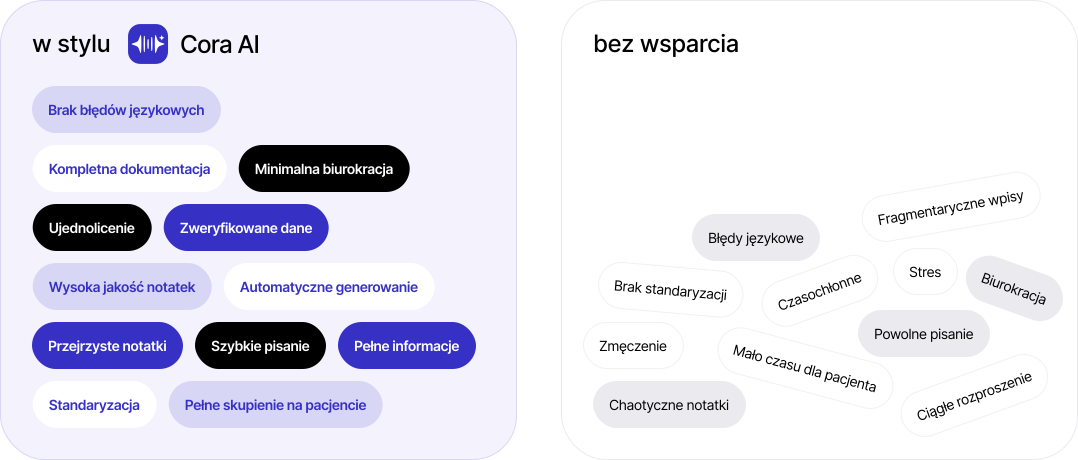
Before and after deployment
Before deployment
- The patient often repeated the same story several times.
- Mostly only the key keywords made it into the documentation.
- The doctor filled in information during or after the visit.
- The computer often pulled attention away from the patient.
- Parents asked follow-up questions only after the exam.
After deploying Cora AI
- The nursing intake reaches the doctor in a more detailed form.
- The doctor starts by clarifying symptoms, not from scratch.
- Exam and documentation happen in parallel.
- The patient feels the staff already knows their story.
- The parent hears the doctor's observations during the exam.
Result: more than 25% less keyboard and mouse usage
The pilot results came faster than the team expected. In exam rooms using Cora AI, keyboard and mouse usage dropped by more than 25%.
In the reality of an emergency department, this is a tangible change in daily work. Less clicking means fewer breaks in the conversation, less looking away from the patient and less documentation reconstructed from memory after the visit.
The biggest change: the doctor can look the patient in the eye
The most important effect of the pilot isn't only about time or number of clicks. It's about the quality of patient contact.
„I can finally look the patient in the eye. Listen, respond, empathise."
For medical staff, technology became support rather than another obligation. Cora AI took over part of the administrative work, allowing the doctor to be more present during the conversation and the exam.
„It gives a huge sense of calm. For us and for the patients. They don't have to ask after the exam, because they hear everything during it. And I don't have to reconstruct the visit from memory afterwards."
Safety and control on the staff side
Cora AI supports documentation creation but doesn't replace medical staff. The system only runs when the patient consents to using the solution during the conversation. The doctor and medical staff retain full control over the documentation content, review and sign-off.
AI doesn't make medical decisions. Its role is to offload staff from administrative work and help organise the information from the conversation. That matters especially in a hospital environment, where it's not only about efficiency but also accountability, data security and compliance with the institution's procedures.
Technology that doesn't take the human out of medicine
The Cora AI deployment in the Emergency Department showed that automating documentation doesn't have to mean distancing staff from the patient. On the contrary — well-deployed technology can help recover what matters most in medicine: attention, conversation and trust.
„I am absolutely convinced by this solution. It's real help, not a gadget."
After the pilot, the hospital is planning to scale the system to other departments, which have started watching the emergency department's work and the effects of documentation automation closely.
„If technology can reduce bureaucracy and improve quality of care at the same time, that's exactly the direction modern medicine should be heading."
Case study summary
The Emergency Department at Dziekanów Leśny Hospital deployed Cora AI to reduce the administrative burden on medical staff and improve documentation created during nursing intakes and physician exams. The pilot showed that voice-to-text can genuinely change the daily work of a medical team.
- More than 25% less keyboard and mouse usage in exam rooms using Cora AI.
- More information from the nursing intake available to the doctor.
- Less repetition of the same story by the patient.
- More eye contact and attention during the visit.
- Smoother communication with parents and patients.
- Less documentation reconstructed from memory after the exam.
Frequently asked questions
How much did keyboard and mouse usage drop after deploying Cora AI?+
In the Emergency Department exam rooms using Cora AI, keyboard and mouse usage dropped by more than 25% — even though not every patient consented to recording and the system wasn't rolled out to the entire staff.
Does Cora AI replace medical staff?+
No. Cora AI supports staff in creating documentation, but the doctor and nurse retain full control over the content, review and sign-off. AI doesn't make clinical decisions.
Is patient consent required?+
Yes. The system only activates when the patient gives consent to use the solution during the conversation.
How does Cora AI improve the quality of the nursing intake?+
The nurse no longer has to type and talk at the same time. More information lands in the documentation in a structured form, and the doctor receives a more detailed intake before starting their own conversation with the patient.
Does the solution only fit large hospitals?+
No. Cora AI works wherever medical staff talk to patients and create documentation — from large hospitals through emergency departments and clinics to single specialist offices.